Tuta, the German encrypted email provider, has released a free integration with Nextcloud, the self-hosted cloud storage and collaboration platform. The company announced it on October 1 and promoted a video walkthrough on X on October 2. It has two parts: a Tuta Mail app listed in the Nextcloud App Store, and a Nextcloud plugin inside Tuta itself. Together they let people save Tuta email attachments to their Nextcloud storage and add a Nextcloud Talk meeting link to a Tuta Calendar event. The catch, according to Tuta's own post and to reporting from Reclaim The Net, is that a Nextcloud administrator has to install the app first, so people on a work or hosted account may need someone else's approval.
What Tuta Released
The first piece is the Tuta Mail app. Tuta says it can be installed with one click from the Nextcloud App Store on either a locally hosted or a managed Nextcloud instance, and then used much like the Tuta web client inside the Nextcloud suite. Reclaim The Net adds that the listing requires version 35 of the Nextcloud server and is published by Tutao GmbH.
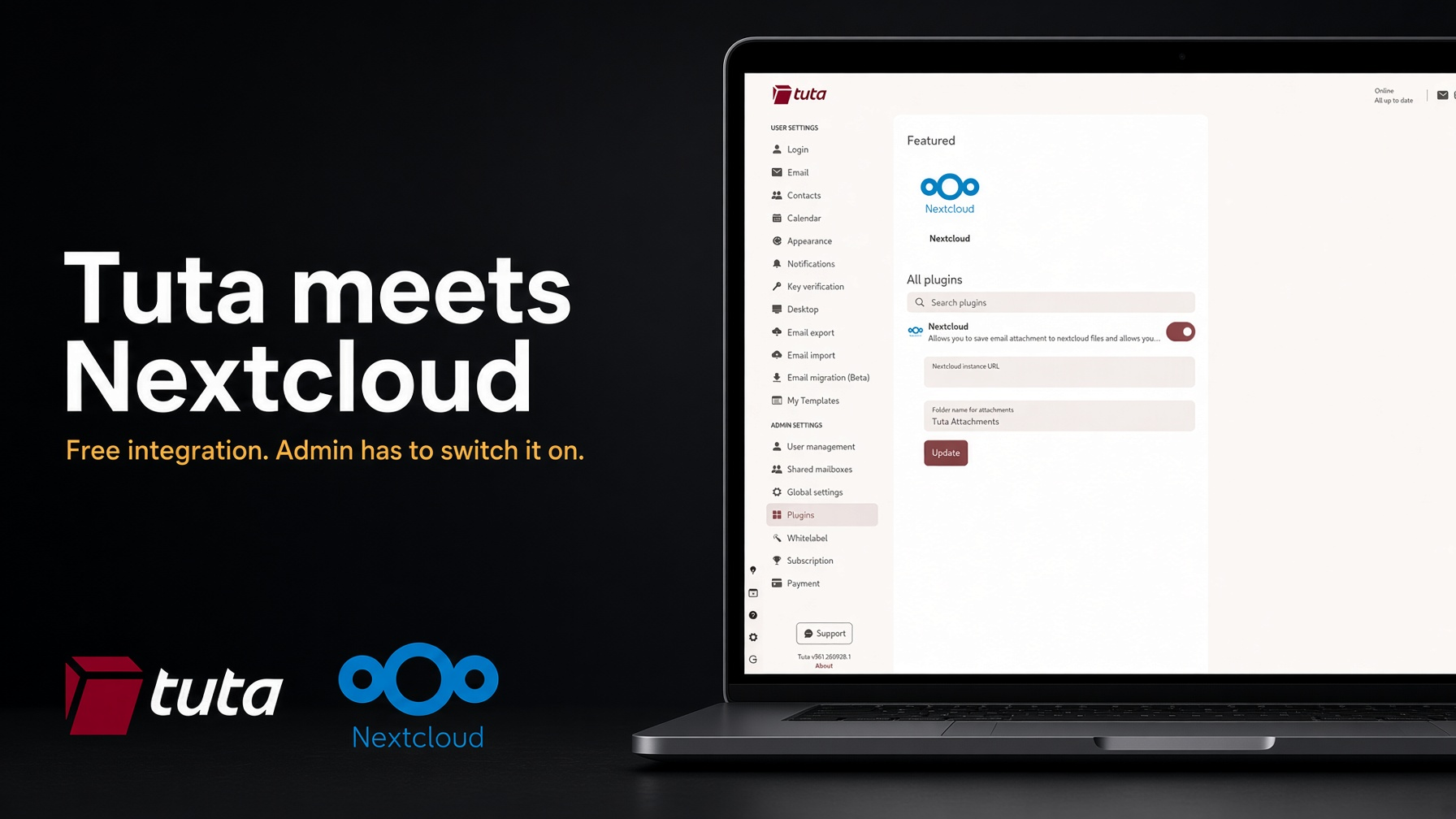
The second piece is the plugin inside Tuta. An admin turns it on for every user of a Tuta account under Settings, then Plugins. Once it is active, Tuta says users can send an attachment from Tuta Mail to Nextcloud with a single click, and create a Nextcloud Talk link from the location settings when they set up a Tuta Calendar event. Tuta also states that this only works if the Tuta Mail app is installed on your own Nextcloud instance.
A third feature, sending Nextcloud files through Tuta Mail, is described by Reclaim The Net as coming soon. Tuta's own post does not list it, so treat that one as unconfirmed for now.
Watch the Walkthrough
Tuta's X post links the video on both YouTube and Invidious, an alternative front end for YouTube. We've embedded the Invidious copy below.
Who Can Actually Switch It On
Here the integration stops being a one-click affair for many people. Tuta says that a family or business using Tuta Mail needs its Nextcloud admin or provider to allow Tuta inside Nextcloud. A single Tuta user is the admin of their own account and can enable the plugin themselves, though the app still has to be installed on a Nextcloud instance they control. Reclaim The Net reads this as a dependence on the provider's decision for anyone whose Nextcloud runs on a company or organization server.
For individuals, that points toward running your own instance. Our StartOS page, for example, notes that the self-hosting operating system lists Nextcloud among the services that can be installed from the Start9 Marketplace. That is general background, not part of the announcement, and Tuta does not recommend any particular hosting route.
Why Tuta Is Doing This Now
Tuta frames the move as a response to demand. In its post, the company says users increasingly want to replace Big Tech services with several sovereign tools rather than one that creates a new lock-in, and describes the result as "all free and 100% European". It is also pitching the pair as a way to replace Microsoft 365 and Google Workspace. The Nextcloud plugin is Tuta's first officially supported one, and the company says it has published documentation and guidelines on GitHub so others can write their own, following a Thunderbird add-on released recently. According to Reclaim The Net, Nextcloud CEO Frank Karlitschek welcomed the work as interoperability that strengthens the open source ecosystem against closed Big Tech platforms.
Reclaim The Net is more reserved about the user experience. It points out that Tuta itself acknowledges people want to avoid swapping one lock-in for another, and asks how many conditions and hoops someone has to clear to reach real digital sovereignty. The admin requirement is the clearest example of a hoop, set against the seamless description in Tuta's X post.
Where the Tools on Our Site Fit
Our listings give a sense of what each side brings. Tuta Mail end-to-end encrypts emails, contacts, and calendar entries, and Tuta Calendar encrypts entire events, including titles and reminders, so that Tuta's servers do not see them. Nextcloud offers self-hosted storage with optional end-to-end encryption, and Nextcloud Calendar is its self-hosted CalDAV calendar.
That makes the Talk link feature interesting. Someone can keep their events in Tuta Calendar and still use Nextcloud's meeting rooms, rather than choosing between the two calendars. Whether that trade-off is worth it depends on how much of the event data the Talk link exposes to the Nextcloud server, and the announcement does not say.
Sources
- Tuta Blog, "The Tuta app has landed in the Nextcloud App Store!," October 1, 2026: tuta.com
- Tuta on X, "WATCH: Tuta Meets Nextcloud!," October 2, 2026: x.com/TutaPrivacy
- Reclaim The Net, "Tuta Mail App Launches in the Nextcloud App Store," October 1, 2026: reclaimthenet.org
- Tuta Mail app in the Nextcloud App Store: apps.nextcloud.com
- Tuta video, "Tuta Meets Nextcloud! Say hello to a seamless privacy integration": youtube.com
This article was written by DigitalEscapeTools based on Tuta's announcement, Reclaim The Net's reporting, the tool listings on this site, and publicly available information at the time of publication.